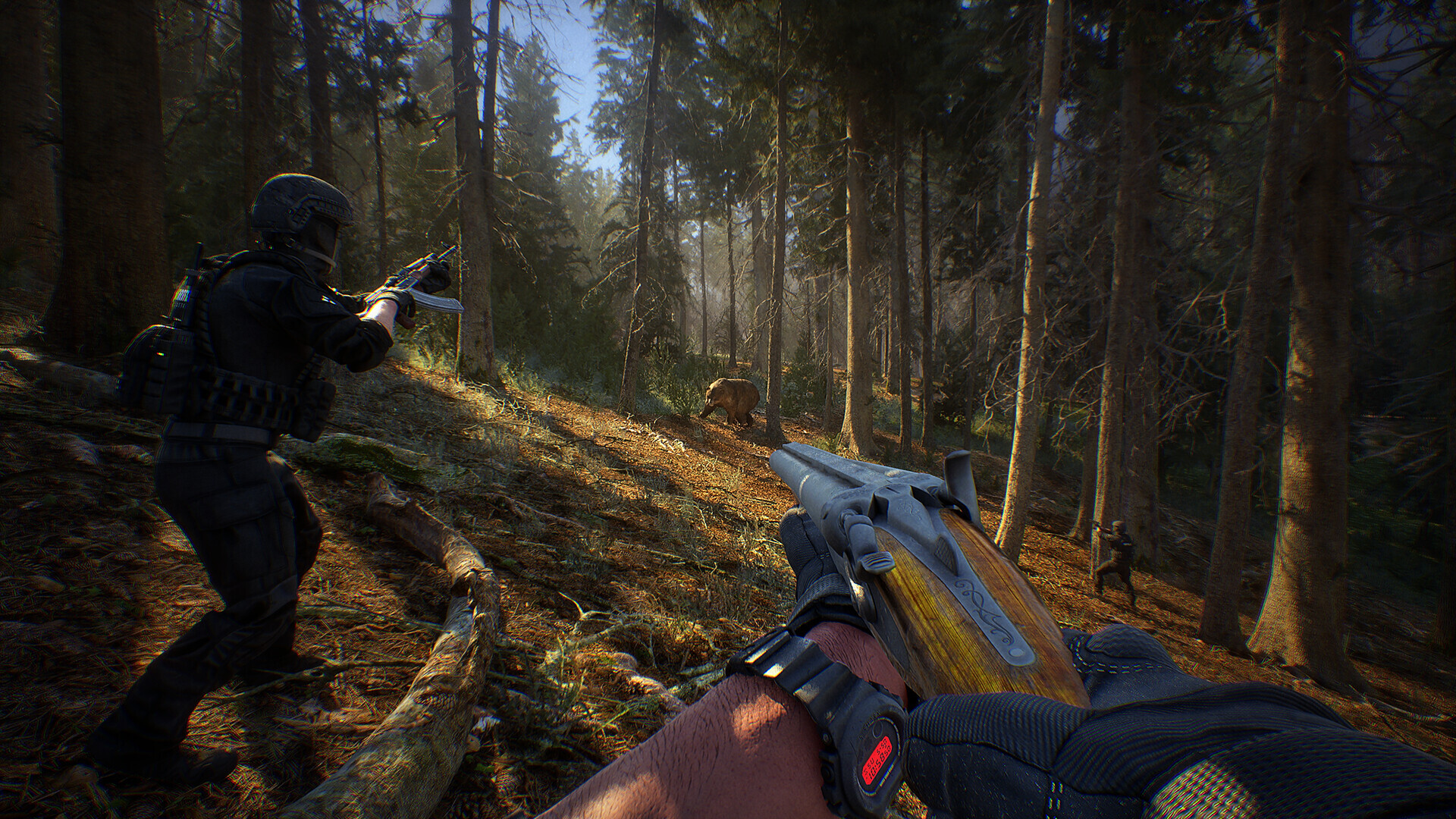
Hunger management, radiation and inventory space are one decision in Phantom Line: Prologue, not three. Hunger and hydration do not trigger an alarm — they feed an energy system, and energy runs your stamina, strength and movement speed.
More context
Nothing about that is urgent until it has been dropping for a while, which is why the survival layer is built to be managed before a deployment rather than patched up during one. Radiation, toxic gas and pack space all run against the same budget.
On this page
The four states your Operator runs on
Survival runs on four states: health, hunger, hydration and stamina. Hunger and hydration feed an underlying energy system, and it is that energy — not hunger on its own — that decides how well the rest of your condition holds up.
The degradation is progressive, which is the important part:
| What drops | What it costs you |
|---|---|
Energy | Stamina |
Energy | Physical strength |
Energy | Movement speed |
There is no sudden penalty for letting it slip. A husk that is running low does not announce itself; it just stops doing what you asked it to, a little at a time. The first thing you actually notice is usually that you cannot hold the sprint you were counting on, and by then the cause has been building for a while.
Because the husks are grown rather than mechanical, this applies to every body you inhabit. The husk you parked across a doorway is spending the same energy budget as the one you are fighting in.
Before you deploy
The intended approach is advance planning rather than constant micromanagement. In a warzone with limited supplies, what you take in is decided before you leave:
Fix the route first.
Decide where you are going — open-world sweep, a portal, a specific site — because that decides how long you are out and therefore how much you need to carry.
Set the food and water for that time, not for a comfortable margin.
Provisions are the one line item that cannot be recovered from a scavenged pile if you run it out in the wrong place.
Choose the kit profile and accept what it costs you.
A stealth-tuned loadout protects the run; a heavy assault loadout fights through it. Neither is free in space.
Reserve the room you intend to loot in before you leave.
Inventory space you did not plan for is loot you cannot carry back.
Count the hazard gear into the same budget.
Protective equipment competes with provisions for the same allowance rather than sitting in a separate category.
Re-check the assignment across the squad, not just for yourself.
Gear that one person is carrying is gear the whole operation is relying on.
Food, water and consumables sit inside the same rebuilt, modular system as damage types and character perks, so what you consume interacts with the rest of your condition instead of operating as a separate overlay. That is why "I ate, so I am fine" is not a complete read on a deployment.
For what the first deployment actually asks of you, in what order, see the Prologue walkthrough.
Hunger management once you are on the island
You are not limited to what you scavenge. Wild animals on the island can be hunted and cooked to maintain optimal health, which makes hunting a real second supply line rather than a flavor activity. Cooking matters more than raw catches because the goal is optimal health, not simply calories.
Scavenging still does the rest of the work: resources found in the open world are what you craft and upgrade gear with, and the same sites tend to carry records of what happened on them. The practical split is that animals keep your current body running, and scavenged resources are what fund the next one.
The team has also been testing a heart rate monitor element that gives you feedback on your condition while keeping the on-screen display minimal, so you are being asked to read your own state rather than stare at a bar.
Radiation and toxic gas hazard zones
Radiation and toxic gas exist as hazard zones in the world, and both run through the same rebuilt survival system as hunger and stamina rather than being bolted on as a separate damage overlay. Two things follow from that, and both matter in play.
They stack. Radiation and toxic gas can be layered in the same place, so a zone that looks like one hazard can be two. The condition effects interact with each other, and with your equipment, rather than resolving one at a time.
You will be told through the body, not a meter. Hazard zones deliver their effect through the game's camera system, and the audio reacts to your state — breathing and coughing change according to injuries, stamina, radiation and toxic exposure. When your breathing changes in a place you thought was clear, that is the exposure telling you, not an alarm you can mute.
Protection from a hazard zone is equipment, not a stance. That means the gear that keeps you functional in a toxic or irradiated area is weighed against food, water and the rest of your loadout in the same space budget, and against whatever your squadmates are already carrying.
This modular setup is the framework the hazards were built on, and it leaves room for further hazard types later — biochemical weapons and anomaly-related effects use the same underlying system rather than requiring a new one.
Inventory space as the real budget
Inventory space is one of the explicit constraints on a deployment, and it is the constraint that ties the other two subjects on this page together. The provisions you carry and the room left for what you find are both decided on the same deployment, against each other.
| Space you give | Space you get |
|---|---|
Food, water, consumables | Nothing left over — you survive the trip and bring back less |
Room for scavenged loot | Finding something you cannot carry is the same as not finding it |
Hazard gear | Protection that only applies when you actually enter the zone |
A heavy assault kit | The capability to go through an objective instead of around it |
The practical consequence is that the kit you choose decides what a run is worth as well as how it goes. A heavier loadout suits taking an objective head-on but leaves less room for what you find out there, and resources found in the open world are what you craft and upgrade gear with afterwards. How that spending works is covered in quintessence upgrades, and the loadout-versus-armor trade-off in a squad context is in the co-op guide.